Stylized logo of a phoenix with outstretched wings above a stack of three chevron shapes.

Essential Reading

A curated shelf of foundational works that shaped our approach to Meaning System Science and interpretation under constraint.

Featured Spotlight:

Peter Senge

The Fifth Discipline (1990)

Senge’s classic argues that organizations improve when they can observe their own structure and correct it. It remains one of the most practical and influential guides to modern organizational life, and a strong entry point for leaders who want a rigorous way to think about coordination and recurring failure. Start here for a systems lens, then use the readings that follow to deepen the theory of interpretation, evidence, and closure.
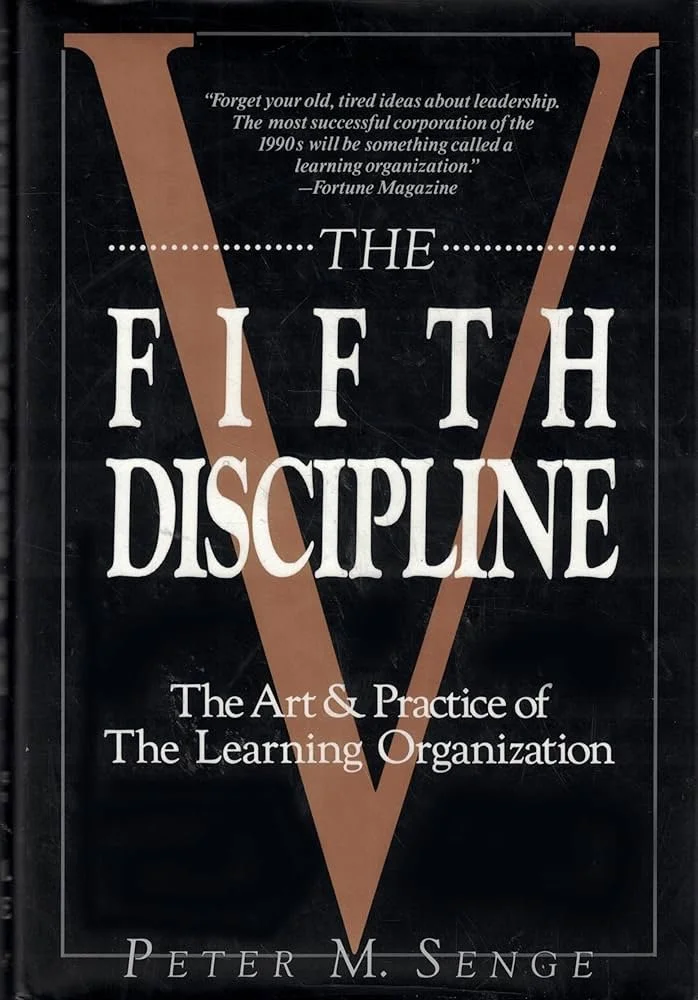
Book cover titled "The Fifth Discipline: The Art & Practice of The Learning Organization" by Peter M. Senge. The cover features a large stylized "V" in the background with a quote at the top and the author's name at the bottom.

At TMI, these are a few of the thinkers whose ideas most shaped how we approach interpretation. The rest of the list expands into additional authors we draw on across the field studies, measurement work, and governance framing.

(T)

  • Logic, Semantics, Metamathematics

    Alfred Tarski (1956)

    Tarski formalizes truth as a relation between statements and explicit conditions of satisfaction. That rigor supports GTOI’s insistence that interpretive claims become evaluable only when the reference conditions are declared clearly enough to permit checking, disagreement localization, and correction traceability. It also disciplines scope. A claim can be true relative to one declared reference and unevaluable relative to another, which aligns with GTOI’s emphasis on declared promises of reality rather than undifferentiated “truth talk.”

  • Truth and Truthfulness

    Bernard Williams (2002)

    Williams treats truth as a practice under pressure: how accuracy and sincerity become socially sustainable, how they fail, and what replaces them when they do. We drew on this orientation when formalizing Truth Fidelity as a system constraint rather than a personal virtue. In applied environments, the question is not whether people “value truth,” but whether the institution maintains conditions where truth claims can remain checkable, revisable, and decisive.

(P)

  • Course in General Linguistics

    Ferdinand de Saussure (1916)

    Saussure clarifies that signals function inside structured systems of difference, not as direct mirrors of reality. That insight becomes operational in Signal Alignment: the quality of interpretation depends on whether signal forms, conventions, and translations preserve action relevance across roles and interfaces. When alignment fails, the same referent can be “named” repeatedly while meaning shifts across layers, creating apparent agreement with incompatible action implications.

  • The Mathematical Theory of Communication

    Claude Shannon and Warren Weaver (1949)

    Shannon’s program shows what becomes possible when “meaning” is bracketed and information is treated as a measurable property of signal transmission. We treat that bracketing as a key boundary: Signal Alignment requires transmission discipline, but meaning cannot be reduced to transmission. The GTOI move is to keep Shannon’s rigor while reintroducing the missing layer: reference promises, evidence thresholds, and closure protocols that decide what a signal will count as in action.

(C)

  • General System Theory

    Ludwig von Bertalanffy (1968)

    Bertalanffy provides the conceptual bridge from parts to organized relations: why system behavior depends on architecture, coupling, and boundary maintenance rather than local optimizations. Structural Coherence uses that lineage to treat interpretive reliability as an engineered property of interfaces and decision pathways. In practice, coherence failures show up as stable contradictions across forums, discontinuities in authority routing, and incompatible closure rules across time.

  • The Sciences of the Artificial

    Herbert A. Simon (1969)

    Simon frames design as the discipline of building artifacts that behave reliably under constraint. We treat interpretation systems as such artifacts, whether institutional or technical. Structural Coherence inherits Simon’s emphasis on bounded rationality and decision environments: coherence is not omniscience, it is the capacity to keep the same decision object stable across roles, records, and handoffs so that action remains coordinated.

(D)

  • Order Out of Chaos

    Ilya Prigogine and Isabelle Stengers (1984)

    Prigogine and Stengers formalize how irreversible processes generate time-directional change and how systems produce order under nonequilibrium conditions. We draw on that lineage when treating Drift as a rate: misalignment accumulates through repeated events when correction mechanisms cannot keep pace with system pressures. The relevance is conceptual and diagnostic: drift is not “error,” it is an observable dynamic across event series.

  • Drift into Failure

    Sidney Dekker (2011)

    Dekker shows how failure emerges from normal work and local adaptations rather than from singular breakdown moments. That maps directly to Drift as an event-series property: the system stays functional while the gap between the official account and the operating reference condition widens. The connection to GTOI is methodological: look for the recurring traces in artifacts, thresholds, and closure behavior, not post-hoc narratives about intent.

(A)

  • How Emotions Are Made

    Lisa Feldman Barrett (2017)

    Barrett reframes emotion as a construction process shaped by prediction, concepts, and context. We use this as a grounding influence for treating Affective Regulation as a system capacity, not a personality trait: whether the environment can sustain uncertainty, disagreement, and consequence without collapsing into avoidance, aggression, or symbolic closure. In interpretive work, regulation determines whether the system can keep evidence processing intact when stakes rise.

  • Handbook of Emotion Regulation

    James J. Gross (ed.) (2006)

    Gross’s handbook consolidates mechanisms, measurement approaches, and boundary conditions for regulation research. We treat it as a discipline anchor for keeping “A” operational: regulation must be observable through participation constraints and protocol behavior, not inferred as a private interior diagnosis. The relevance to GTOI is restraint and rigor: define what regulation changes in the system’s interpretive cycle, and specify the traces that show it.

(L)

  • Trust and Power

    Niklas Luhmann (1979)

    Luhmann treats trust as a complexity-reduction mechanism that enables action under uncertainty, and power as a coordination medium with its own logic and failure modes. We treat this as a direct bridge into legitimacy dynamics: institutions require trust to route decisions, and they require power to enforce closure, but the relationship between the two determines whether authority remains stable or becomes contested. The GTOI alignment is structural: legitimacy is an architectural property of how decisions become binding.

  • Groundwork of the Metaphysics of Morals

    Immanuel Kant (1785)

    Kant formalizes legitimacy as constraint that can be justified, not merely enforced. We draw on that frame when treating legitimacy as a governance variable: the question is whether an institution’s constraints can be treated as binding without relying on coercion or charisma. In GTOI terms, legitimacy shapes which closure outcomes remain decisive over time, because it determines whether participants will treat a decision as one that ought to govern action.

First Law

  • Epistemic Injustice

    Miranda Fricker (2007)

    Fricker formalizes credibility and interpretability as moral-epistemic failure classes, not as interpersonal misunderstandings. We use this as a precision lens for reception and routing failures: testimonial injustice names systematic credibility deficits, and hermeneutical injustice names structural gaps in what a system can render admissible. This complements the Law by clarifying that proportional stability is not only about signal quality, but also about whether systems treat certain knowers and certain experiences as eligible for truth-bearing status.

  • Between Facts and Norms

    Jürgen Habermas (1992)

    Habermas formalizes how legitimacy arises when reasons can circulate through procedures that participants can recognize as binding. We treat this as a governance-level complement to the Law: when interpretive claims become high consequence, proportional stability requires more than technical evidence. It requires procedures that can convert facts into enforceable norms without severing the link to justification. That is the bridge between interpretation and institutional closure.

TM

  • The Fifth Discipline

    Peter M. Senge (1990)

    Senge consolidates systems thinking into an applied discipline: how learning environments, feedback structures, and shared models shape organizational outcomes. We treat this as a precursor stance for Transformation Management, especially the idea that structural correction is a primary work object. The link is not motivational. It is architectural: transformation depends on whether the organization can keep its interpretive and governance systems aligned while redesigning itself.

  • The Little Book of Common Sense Investing

    John C. Bogle (2007)

    Bogle is especially useful for Transformation Management because he treats institutional incentives as design variables and insists on measurable alignment between stated purpose and operating structure. We use that stance as a Transformation Management reference: governance is not branding, it is enforced constraint. The relevance is direct for transformation attempts: you can predict failure when incentives and authority routing contradict the declared promise, even when the language of change is strong.

The TMI Research Library

These readings offer context. The Research Library offers the science itself. Explore our Curated Reading Paths.

Explore the Library