

The Interpretive Process
The interpretive process specifies the conditions under which meaning becomes action-governing in systems that must manage how actions are chosen under constraint.
Meaning does not guide behavior simply by being present, believed, or stated. Meaning guides action only when interpretation becomes binding within an authority structure. This page lays out the full process by which interpretation activates, becomes binding, routes action, persists over time, and reopens when coordination breaks down.
Interpretation is a governance process, not a psychological one. It operates only in systems where multiple possible actions must be coordinated, such as human, organizational, and institutional settings.
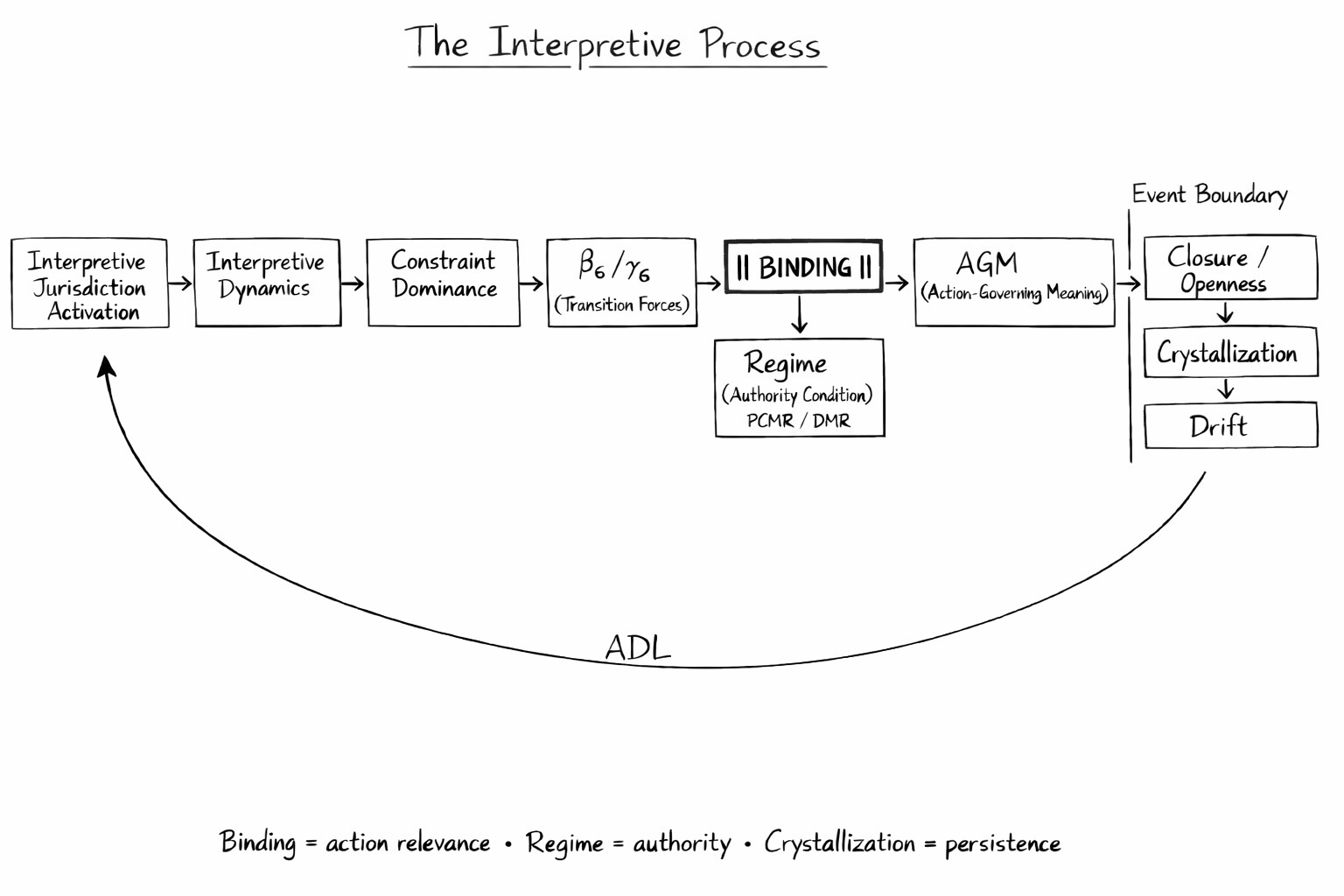
Canonical Process Description
The interpretive process unfolds in distinct phases.
A. Event Activation
1. Interpretive Jurisdiction Activation
An interpretive event activates when a reference condition becomes decision-relevant within an admissible system boundary.
Interpretive jurisdiction fixes:
whose interpretation counts
under what authority binding is possible
which system is responsible for action
Jurisdiction is a precondition for binding. Without jurisdiction, interpretation may occur, but obligation cannot.
B. Pre-Binding Operations (Event-Internal)
2. Interpretive Dynamics
The system generates and evaluates multiple interpretive candidates.
candidates compete for commitment
variability is preserved
no obligation exists
no action is yet required
Interpretive dynamics regulate candidate evaluation under constraint, not response selection.
3. Constraint Dominance
(Law of Constraint Dominance)
Constraint reaches a level at which continued deferral is no longer viable under the operative reference conditions.
the cost of delay exceeds the cost of commitment
interpretation must resolve to a governing candidate even when information is incomplete
Constraint dominance necessitates binding but does not select a candidate.
4. Transition Forces (β₆ / γ₆)
As binding approaches, transition forces act on interpretive variability:
β₆ (Transition Drivers) compress variability and accelerate threshold crossing
γ₆ (Transition Stabilizers) preserve variability, soften threshold crossing, and increase reversibility near threshold
Transition forces shape commitment timing and reversibility, not candidate identity.
C. Governance Hinge (Event-Internal)
5. Binding
Binding is the hinge of the process.
A single interpretive candidate becomes action-relevant within the event.
obligation appears
alternatives are excluded from governing status
meaning acquires force
Binding does not imply legitimacy, event closure, or persistence across time.
6. Regime (Authority Condition)
At binding, meaning governs under an authority condition (regime).
Two regime states are possible:
PCMR — Post-Closure Meaning Regime
binding under legitimate (de jure) authority conditionsDMR — De Facto Meaning Regime
binding without legitimate authority, despite action occurring
Regime is a governance classification, not a temporal one. It is operative at binding and is not produced by crystallization or persistence.
7. Action-Governing Meaning (AGM)
Once bound, meaning becomes action-governing within the active interpretive event.
AGM constrains the response space by specifying what is:
permitted
required
deferred
prohibited
AGM is the force-bearing state of meaning.
D. Operational Consequence (Event-Internal)
8. Response Routing
Response routing is the event-internal operation by which AGM is mapped to an authorized response pathway.
Routing presupposes AGM and action determinacy. Determinacy conditions govern whether routing can be completed under the existing baseline without reinterpretation.
Routing selects an operational pathway without creating meaning, revising authority, or resolving the Event Closure State.
E. Event Closure State
9. Closure or Explicit Openness
The system resolves the interpretive event to one of two states:
closure, or
explicit openness
Closure ends the event. Explicit openness defers closure without dissolving the binding that currently governs action.
Event Closure State does not determine regime and does not determine persistence.
F. Persistence Classification (Post-Event)
10. Crystallization
Crystallization classifies whether the bound meaning persists across cycles.
if crystallized, the bound meaning becomes a governing baseline
if not crystallized, the bound meaning expires as event-local governance
Crystallization does not create authority and does not create regime.
If crystallization occurs, the regime operative at binding (PCMR or DMR) continues as the authorization condition under which the baseline governs across cycles.
G. Temporal Behavior (Post-Event)
11. Drift
Drift is the post-crystallization rate of inconsistency accumulation over time in a governing baseline under load and correction limits.
Drift is downstream of crystallization and modulates baseline stability across cycles.
H. Re-Opening Trigger (Post-Event)
12. Action Determinacy Loss (ADL)
Action Determinacy Loss (ADL) occurs when an existing crystallized governing baseline can no longer deterministically route response selection relative to the reference conditions treated as in force.
When ADL occurs:
routing cannot proceed under the existing baseline
interpretive jurisdiction reactivates
a new interpretive event begins
ADL is a threshold, not a rate. It closes the loop of the interpretive process.
Core Invariants
interpretation ≠ obligation
binding assigns action relevance
AGM is the force-bearing state of event-internal meaning
regime classifies authority conditions at binding
Event Closure State classifies closure versus explicit openness
crystallization classifies persistence across cycles
drift is a post-crystallization rate
ADL reopens interpretation by loss of determinacy in a crystallized baseline